How to Rent an Apartment With a Broken Lease in Houston
A broken lease doesn't have to block you. Here's how it appears on screening, your debt options, and which Houston communities approve.

We review hundreds of background checks across Houston every month. Renters often assume that breaking a lease guarantees an automatic denial everywhere.
The reality is far more nuanced in the current 2026 market.
Our experience shows that a broken lease is almost always less of a barrier than a full eviction. Your actual approval odds depend entirely on how you handle the underlying property debt.
This guide to renting with a broken lease outlines exactly how screening software works and provides practical ways to secure your next apartment.
How a Broken Lease Shows Up on Screening
We see broken leases appear on screening reports in three distinct ways. The prior community will typically take one of the following actions regarding your remaining balance:
- Reports the rental debt to a collection agency: This appears on your credit report and rental history.
- Writes off the debt internally: This may still appear on rental-history reports under a “writeoff” line, but it does not always impact your credit score.
- Sends it to court: This turns into a small-claims judgment or a Forcible Entry and Detainer record.
Our goal is to help you avoid wasting $50 to $75 on non-refundable application fees. Applying blindly is dangerous because major tenant-screening services like RealPage and SafeRent use automated databases. These platforms frequently pull data from LexisNexis to flag rental debt instantly.
We always recommend requesting a free copy of your consumer file from SafeRent Solutions or Experian RentBureau. Reviewing this data lets you see exactly what the leasing office will see. Even if an apartment skips a traditional credit check, the property manager usually catches a broken lease line item on the rental history report.
Pay, Negotiate, or Walk Away, Which?
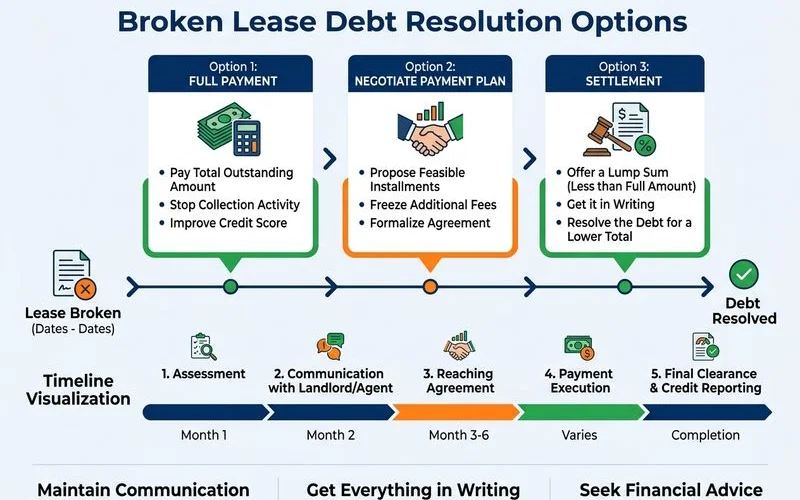
We receive this question more than any other during client consultations. The best path forward depends heavily on the size of the debt and your current savings. Choosing the right strategy dictates whether you get approved quickly or face repeated rejections.
Pay in Full
Our data shows that paying the balance in full is the absolute cleanest option. Paying off the debt gets a “paid in full” or “settled” notation on your rental history. This status dramatically widens your approval options across the city.
We strongly advise taking this route if your balance is relatively small, typically between $500 and $1,500. Clearing a debt under $1,000 often allows you to bypass the need for expensive third-party bonding services. Property managers view applicants with resolved debts as responsible renters who honor their financial commitments.
Negotiate a Settlement
We understand that paying a massive balance is not always feasible. Most collection agencies in 2026 are willing to accept 30% to 60% of the total amount as a final settlement. Debt buyers prefer recovering some money over getting nothing at all.
Our top piece of advice is to get any settlement agreement in writing before you hand over a single dollar. You must confirm the agency will report the debt as “settled” rather than “settled for less than owed.” A clean “settled” status helps your application significantly more than a partially resolved flag.
Don’t Address It (Yet)
We can still find you approvals if you have absolutely no resources to settle the debt right now. You can often secure leases at older garden-style properties or specific second-chance buildings. The trade-off usually involves paying a higher risk fee or a doubled deposit.
Our internal tracking indicates there are roughly 160 apartments that accept broken leases Houston residents can access today. Finding these specific units requires utilizing a third-party bonding service that charges a non-refundable fee. This fee typically equals about one month of rent.
Communities That Approve Broken Leases
We track community guidelines constantly because far more Houston properties approve broken leases than evictions. Finding the right fit requires targeting specific neighborhoods and property types. Submitting applications to strict luxury buildings will only waste your money.
Our placement statistics reveal clear patterns regarding which broken lease apartments Houston renters get approved for most often:
- Garden-style properties: Communities in submarkets like Spring Branch, Pasadena, Baytown, parts of Memorial, EaDo, and Humble/Kingwood often approve broken-lease applicants. They frequently do this without requiring significant added costs.
- Mid-rise properties: Newer communities often approve applicants by charging a risk fee of $300 to $700. They might also require a slightly higher security deposit.
- Luxury communities: High-end buildings are the strictest option on the market. Many of these properties auto-deny broken leases regardless of your settlement status.
We maintain a proprietary database that tracks exactly which communities accept specific broken-lease patterns. Your match list is curated specifically to the financial situation you actually have. Applying to buildings with a high vacancy rate, like those currently averaging 97 days on the market in 2026, also improves your chances.
What If the Prior Community Was Wrong?
We regularly meet clients who broke their lease for legally protected reasons. Texas law does not consider your departure a true broken lease if you leave due to extreme, unavoidable circumstances. You must provide the correct legal documentation to claim these protections.
Our team recommends familiarizing yourself with the specific statutes that mandate early lease termination without penalty:
- Texas Property Code Section 92.016: Protects victims of family violence who provide a valid protective order or documentation from a licensed health care provider.
- Texas Property Code Section 92.017: Protects military personnel undergoing active-duty relocations.
- Texas Property Code Section 92.056: Protects tenants forced to leave due to uninhabitable conditions after the landlord fails to make necessary repairs.
Bringing all supporting paperwork directly to the leasing office during your initial tour is highly recommended. Many communities will treat your case as a clean rental history once they review the official documents.
We suggest politely requesting that the property manager manually override the screening software flag. Please note that our team members are not attorneys. Consulting with a qualified legal aid resource is your best option if your case involves a complex legal matter.
Letters of Explanation
We highly recommend drafting a short letter of explanation to accompany your rental application. A well-written letter provides the human context that an automated screening algorithm completely ignores. Property managers reading hundreds of applications appreciate brevity and honesty.
Our most successful clients use a very specific structure to outline their past circumstances:
- The circumstance: Clearly state the reason for the broken lease, such as a job loss, medical emergency, or military move.
- Your recovery: Explain what you have done since the event, like paying the debt or maintaining a stable job for a specific number of months.
- The assurance: Provide a factual statement detailing why this financial hardship will not happen again.
Most communities that approve broken leases under conditional terms require this document before finalizing the lease. Attaching your settlement receipt directly to this letter provides undeniable proof of your current financial responsibility.
We offer writing assistance for these letters as a standard part of our free locating service.
Move-In Cost Math
We want you to be fully prepared for the financial realities of second-chance renting. Getting approved with a risk fee or a higher deposit requires having more cash on hand at signing. Planning for these extra costs prevents last-minute surprises on move-in day.
Our clients typically encounter two main types of conditional approval fees:
| Fee Type | Estimated Cost | Refundable Status |
|---|---|---|
| Risk fee | $300 to $700 | Non-refundable |
| Doubled deposit | $1,200 to $2,800 | Refundable upon clean move-out |
The average rent in Houston hovers around $1,345 in 2026. A doubled deposit based on that average means you need a substantial amount of money upfront.
We know that comparing these managed costs to the pain of an open-ended search puts the numbers into perspective. Avoiding multiple $75 rejection fees makes these higher deposits feel much more manageable. Your budget is protected because our pre-screening process gets you to an “approved” status with just one application instead of five.
Our team is ready to help you manage this process from start to finish. Start your free second-chance search today, or read more about the true cost of second-chance renting to prepare your budget.