Can You Rent in Houston With an Eviction on Your Record?
Yes, you can rent in Houston with an eviction. Learn how paid vs unpaid evictions screen, what look-back windows mean, and which communities approve.

As a renter in Texas, you know how stressful the background check process feels after a financial setback.
Houston Second Chance Apartments was founded with a simple mission, which is to provide exceptional real estate locating services that customers can truly rely on. We understand that finding apartments that accept evictions in Houston feels impossible when every application ends in an automated denial.
The short answer is yes, you can rent a Houston apartment with an eviction on your record. The outcome depends on whether the eviction is paid or unpaid, how long ago the judgment occurred, and the exact property you choose. Let’s look at the data behind the tenant screening process and explore practical ways to get your application approved today.
How an Eviction Shows Up
An eviction appears as a permanent court record that triggers red flags in background check systems. In Texas, courts officially call this a Forcible Entry and Detainer (FED) action, which happens when a landlord sues to remove a tenant under Property Code Chapter 24.
Once filed at a Harris County Justice of the Peace Court, this FED record is permanent in the legal system. It will surface in tenant screening reports for up to seven years.
We see this impact renters daily. Over 6,300 eviction cases are filed each month across Harris and Galveston counties according to 2026 data.
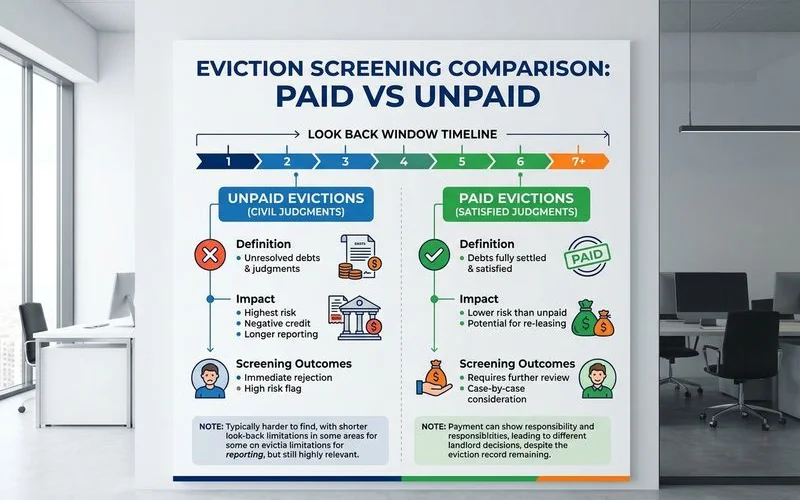
Property managers run these applications through popular tenant screening software like TransUnion SmartMove or RentSpree. These programs pull data from two completely different places.
First, the software flags the physical court record of the FED lawsuit. Second, if you owe back rent or court fees, that rental debt gets reported to collections and dings your credit score.
This means a single event often creates two massive hurdles on your record.
These screening platforms look for three specific red flags:
- The initial Forcible Entry and Detainer lawsuit filing.
- The final court judgment granting possession to the landlord.
- Any unpaid balances sent to third-party debt collectors.
Paid vs Unpaid — Why It Matters
Most Houston communities treat a settled eviction completely differently than an unpaid balance. An unpaid eviction with active debt faces the strictest screening, while paying off the balance opens up many more housing options.
Our team has learned exactly why landlords are so strict about this. The average eviction costs a property owner between $3,500 and $10,000 in legal fees, lost rent, and turnover expenses.
Property managers simply cannot afford to risk a repeat scenario. That financial fear dictates their approval rules.
Here is a breakdown of how complexes view different records:
- Unpaid eviction with active debt: This triggers an automatic denial at most properties. If a community does approve you, they will likely demand a guarantor or a massive deposit.
- Paid eviction (debt settled): The court record still exists, but zeroing out the debt proves you take financial responsibility. This drastically softens the screening criteria.
- Dismissed eviction: This is the easiest hurdle to clear. If a judge dismissed the case or you signed a Rule 11 settlement agreement before a judgment, many communities will ignore the filing.
If you have an unpaid balance, you should try to negotiate the debt before applying for a new place. Some collection agencies will accept a 30 to 50 percent settlement to close the account.
We can guide you toward specific properties that work with partial settlement situations. Settling the account is the fastest way to improve your odds.
Look-Back Windows
Apartment communities do not hold an eviction against you forever. Management companies use specific look-back windows, usually ranging from two to seven years, to evaluate your past rental history.
Our data shows that the age of the judgment is just as important as the debt amount. The Fair Credit Reporting Act limits how long debt collectors can report unpaid rent, capping it at seven years.
Because of this law, the strictest properties simply look back for that full seven-year period. However, many leasing offices in 2026 are adopting more realistic timeframes.
Here are the standard look-back windows used in the city:
- Strictest properties: 7 years (the maximum legal reporting window).
- Standard properties: 3 to 5 years after the judgment date.
- Lenient properties: 2 years or less.
If your court date was more than four years ago, your list of options expands significantly. If the event happened within the last 12 months, you will face a narrower set of choices.
You can still secure a great place with a recent record if you apply to the right management company.
Communities That Approve
You will not find a public directory of apartments that accept evictions in Houston. Instead, certain properties run lenient screening criteria while others offer conditional approvals based on your specific background.
Be very cautious of any online locator promising a guaranteed list of forgiving landlords. The reality of finding second chance apartments after eviction is much more nuanced.
A dedicated locator service targets older, garden-style properties because they offer the highest approval odds for renters with past evictions.
Our locators track internal property management guidelines across the entire metro area. Industry data shows that older, garden-style properties are often the most flexible.
You will typically find these lenient criteria in submarkets like Spring Branch, Pasadena, parts of Memorial, Baytown, and EaDo. A property located on Wirt Road in Spring Branch will likely have very different rules than a brand-new high-rise downtown, which almost always requires conditional terms like a risk fee.
We curate your property match list against your specific financial situation. This targeted approach prevents you from wasting expensive application fees on guaranteed denials.
Garden-Style vs. Newer Builds
Understanding the difference between property types helps set the right expectations for your search. Here is a quick comparison of what you can expect when applying.
| Property Type | Typical Location | Eviction Flexibility |
|---|---|---|
| Older Garden-Style | Spring Branch, Pasadena, Baytown | Highly flexible, often accepts recent or unpaid evictions. |
| Mid-Tier Renovated | EaDo, Memorial | Moderately flexible, usually requires a paid eviction or older record. |
| New Construction | Downtown, Galleria, Medical Center | Strictly conditional, almost always demands risk fees or double deposits. |
This breakdown highlights why targeting the right neighborhood is just as important as having the right paperwork.
What About a Letter of Explanation?
A letter of explanation is a simple, one-page document that tells the property manager the story behind your eviction. Many forgiving communities request this letter to justify approving an applicant who falls outside their normal criteria.
Our staff reviews hundreds of these letters every year. The biggest mistake renters make is writing a long, emotional essay that fails to address the financial facts.
Property managers just want to know that the financial crisis is completely resolved.
Here is the exact format that works best:
- Brief context: State the root cause plainly, such as a sudden job loss or an unexpected medical emergency.
- Your corrective actions: Detail exactly what you have done since the court date, highlighting stable employment and settled debts.
- Future stability: Explain why this issue will never happen again by pointing to your current income or healthy savings account.
Keep the entire document under 300 words. A short, honest explanation always beats a complicated excuse.
We actually help our clients write these letters as part of our free placement service.
Risk Fees and Higher Deposits
Communities often counter a weak rental history by requiring a non-refundable risk fee or a doubled security deposit. These extra costs are not financial punishments, but rather safety nets that allow the landlord to approve your application.
We constantly monitor these conditional approval trends across the local housing market. In 2026, a standard Houston apartment risk fee typically ranges from $300 to $800.
Always ask if the required upfront payment is a refundable security deposit or a non-refundable risk fee before signing your lease agreement.
This fee is completely separate from your standard security deposit and will not be refunded when you move out.
Some properties might require you to pay two times the normal security deposit instead.
Here is why you must calculate the total move-in cost carefully:
- Option A: A property charges a $400 non-refundable risk fee on top of a standard $300 deposit. Your total extra upfront cost is $700.
- Option B: A property requires a doubled deposit on a $1,200 apartment. You must pay $2,400 upfront, even though you might get it back later.
Our agents will crunch these numbers to find the lowest possible move-in cost for your budget. Sometimes eating a small, non-refundable fee makes much more financial sense than tying up thousands of dollars in a massive deposit.
How to Move Forward
The best way to move forward is to stop guessing and start applying strategically based on your specific background.
We will match your exact history, including whether the judgment is paid or unpaid, against our comprehensive database.
This strategy ensures you only look at properties that are highly likely to approve you. Here is how our process protects your wallet:
- We target properties that fit your specific financial profile.
- You skip the automated rejections from strict management companies.
- You save hundreds of dollars on wasted application fees.
To understand the technical side of the approval process, read how tenant screening software flags applicants.
If you are ready to rent with an eviction houston properties accept, you can start your free second-chance search today.