A broken lease on a rental record does not mean the same thing for every Houston renter who has one. Whether the broken lease resulted in no remaining debt, left an outstanding balance with a prior landlord, or is happening right now - currently active - determines which approval paths exist and which Houston communities are realistic targets.
Getting that clarity before applying anywhere saves application fees and shapes the entire strategy.
Start Here: Pull the Free Credit Report
Before approaching any Houston apartment community, the first step is pulling a free annual credit report from annualcreditreport.com. This is the federally mandated site where renters can access their reports from Equifax, Experian, and TransUnion - and it shows what a leasing office will see when it runs a credit check.
Specifically, a renter is looking for any account tied to a prior lease. Outstanding balances from former landlords may appear as an open account still owned by the original property management company, or as a collections account that was sold to a third-party debt buyer after the balance was written off. Either entry signals a Scenario 2 situation - and knowing that before walking into a leasing office changes which strategy to use.
If nothing appears on the credit report related to a prior lease, that narrows the situation to either Scenario 1 (no debt remaining) or Scenario 3 (currently in an active broken lease), depending on timing.
One critical distinction: rental history screening through RealPage, AppFolio, or Yardi is a separate layer from credit bureau reporting. These platforms pull directly from property management company databases and can surface lease history that does not appear on any credit report. A broken lease that predates the credit bureau reporting window may still show up in a Yardi rental history report. Pulling the credit report is the starting point - the rental history databases are a second layer that the Houston Second Chance Apartments team reads on the renter’s behalf before any application fee is paid.
The Three Broken Lease Scenarios
Every Houston renter with a broken lease on their record falls into one of three situations. Each has a distinct pool of communities and a different set of approval tools.
Scenario 1: Prior Broken Lease, No Remaining Debt
This is the most workable situation and the one that opens the widest set of options across the Houston market.
The renter left a lease before the end date at some point in the past - weeks, months, or years ago - but does not owe any money to the prior property. The balance was resolved at the time, written off with no remaining obligation, never escalated to collections, or has since been paid in full.
Most Houston property management companies screen rental history through RealPage, AppFolio, or Yardi with look-back windows of three to five years. If the broken lease is old enough to fall outside that window, it may not appear in the screening results at all. At that point, approval follows standard credit and income criteria, and the broken lease is essentially invisible to the screening system.
When the broken lease does appear within the look-back window but no balance is attached, a letter of explanation is usually sufficient to clear it at most Houston communities. Some properties may request a slightly higher security deposit as a precaution, but a straightforward denial is uncommon when no money was left on the table at the previous property.
Renters in Scenario 1 have the broadest pool of communities available across the Greater Houston metro. Easy placement is the typical outcome with the right guidance on which communities to approach and how to present the explanation.
Scenario 2: Broken Lease with Outstanding Rental Debt
Scenario 2 is more constrained. The renter left a prior lease early and owes money to the original property - early termination fees, unpaid rent, damage charges, or some combination. That balance may remain with the original property management company or may have been transferred to a third-party collections agency.
Outstanding rental debt narrows the field significantly. Several factors shape how manageable the situation is:
Balance amount is a primary variable. Balances under $1,500 are more workable than balances in the several thousands. The amount outstanding directly affects which approval paths are available and what conditions a community will require.
Payment activity matters. A renter who is actively making payments on the debt - even partial payments toward a collections account - demonstrates that the situation is being addressed. Some Houston communities weigh that differently than a completely ignored balance.
Recency affects scrutiny. A broken lease debt from two years ago screens harder than one from four or five years ago. More recent debt increases the likelihood of a conditional approval requirement rather than a clean approval.
Income strength can compensate. Strong current income documented above 3x monthly rent can offset outstanding rental debt at communities that weight income documentation heavily in their approval process.
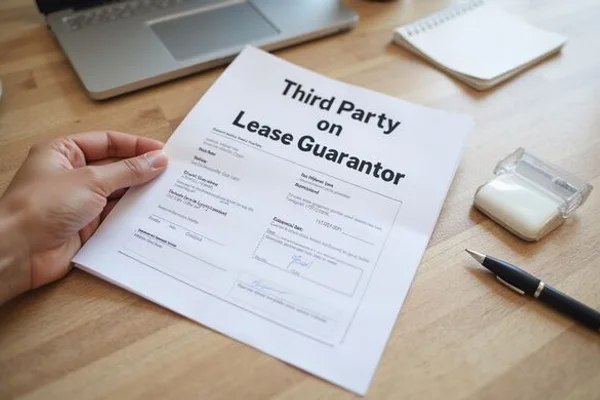
When outstanding rental debt is the primary barrier, third-party lease guarantors become the central tool. The four platforms Houston Second Chance Apartments coordinates with regularly for Scenario 2 situations:
Liberty Rent provides a lease guarantee and deposit alternative that covers the property’s risk exposure when the renter cannot meet standard deposit or rental history thresholds. Liberty Rent tends to be more flexible on recent credit events and shorter post-incident timelines, which makes it well-suited for renters whose broken lease debt is relatively recent.
The Guarantors is an institutional guarantor that underwrites the renter’s full financial picture. The platform is particularly useful when the rental debt amount is significant but current income is strong - the guarantor’s backing shifts the risk calculation for the leasing office from the renter’s history to institutional coverage.
Cosign connects renters with qualifying co-signers when no personal co-signer is available in the renter’s own network. For renters whose income and employment are stable but whose rental history flag is generating the denial, a Cosign-matched co-signer can function as an alternative to a corporate guarantor structure.
OneApp Guarantee creates a single application backed across participating Houston communities. This is particularly useful for renters who have already spent money on application fee denials - OneApp reduces the repeat-fee problem by creating one underwritten profile that participating communities can review directly.
Not every Houston community accepts every guarantor platform. Confirming platform acceptance before paying an application fee is where inside knowledge matters most. The Houston Second Chance team verifies platform acceptance for each community before a renter pays anything.
Other Scenario 2 paths include settling or partially paying down the outstanding balance before applying, negotiating a direct payment plan with the original property management company, and identifying income-only verification communities where the screening threshold for rental debt is more lenient.
Scenario 3: Breaking a Lease Right Now
Scenario 3 is the most constrained situation: the renter is currently in a lease and needs to leave - for an unsafe living situation, job relocation, income loss, habitability issues, or another urgent reason. The broken lease is active and current.
A currently active broken lease appears immediately on any rental history verification run by a screening platform. Standard systems flag it, and the standard approval paths for Scenarios 1 and 2 do not apply because the lease has not yet closed out.
The realistic path for Scenario 3 is Houston communities that do not verify prior rental history, or that rely primarily on income and credit screening without contacting previous landlords as part of the application review. These communities exist across the Houston metro, concentrated in higher-turnover submarkets where competition for residents pushes communities toward more flexible screening policies.
Lease-up properties in early fill phases are a second avenue. New apartment communities opening across the Houston suburbs sometimes relax screening requirements during the first several months after opening in order to hit occupancy targets. That window closes once the community stabilizes - it is not permanent and not publicly announced.
For Scenario 3 renters, income and credit quality become the primary approval criteria when rental history is not being verified. Renters with clean credit and provable income above 2.5x to 3x monthly rent have a better chance at the communities that screen this way than renters who carry both a rental history flag and a credit issue.
The Houston Second Chance Apartments team tracks which communities currently screen without rental history verification, since that information is not publicly disclosed and changes as each community’s occupancy situation shifts.
Where the Approval Options Are in Houston
Broken-lease approval flexibility across the Greater Houston metro follows occupancy pressure and competition between communities for residents. It is not evenly distributed.
Higher-flexibility submarkets for broken lease renters include Greenspoint, Alief, Sharpstown/Gulfton, FM 1960/Willowbrook, the 290 Corridor, and Southwest Houston. These areas have higher inventory relative to demand, faster resident turnover, and a higher proportion of Class B and Class C communities actively competing for renters. Scenario 2 and Scenario 3 renters are more likely to find workable approval paths in these submarkets than in tighter parts of the market.
Growth suburbs with lease-up activity include Katy, Cypress, Sugar Land, and Pearland, where new developments in lease-up phases regularly relax criteria temporarily to hit initial occupancy targets. These windows are not publicly announced and close as communities stabilize. Scenario 3 renters in particular should watch lease-up activity in these suburbs as a viable short-term path.
Tighter-screening areas like the Galleria, Montrose, and Medical Center hold stricter standards because vacancy rates are lower and competition for Class A units is higher. Lease-up activity in those corridors does create occasional windows for Scenario 2 renters, but Scenario 3 situations are rarely workable in these areas without strong credit and well-documented income.
Houston Second Chance Apartments covers the full Greater Houston metro - Harris, Fort Bend, Montgomery, Brazoria, and Galveston counties - and maintains current screening knowledge across every submarket. Renters focused on a specific area can request a submarket-filtered list, and the team filters to communities with realistic approval paths for the renter’s specific broken lease scenario.
How Pre-Screening Changes the Math
The typical Houston apartment application fee runs $50 to $75 and is non-refundable. For renters with broken lease flags, RealPage and other platforms can generate a denial before a human at the leasing office ever reviews the application - the renter pays the fee and finds out through a rejection email with no further explanation.
Houston Second Chance Apartments pre-screens against community criteria before any application fee is paid. The team maps a renter’s specific situation against the look-back windows, guarantor acceptance, and conditional-approval terms of 1,000+ Houston communities. That means renters apply only where the approval math works for their scenario.
| Feature | Searching Alone | With Houston Second Chance Apartments |
|---|---|---|
| Cost to renter | $50-$75 per application (non-refundable) | 100% free |
| Scenario identification | No guidance | Mapped to the correct scenario before applying |
| Rental history pre-check | None | 1,000+ communities pre-screened for look-back windows |
| Guarantor coordination | DIY research | Liberty Rent, The Guarantors, Cosign, and OneApp Guarantee |
| Scenario 3 community access | Unknown | Tracks which communities skip rental history verification |
Getting Started
Houston Second Chance Apartments can be reached by calling or texting 346-693-7368, or through the contact form at houstonsecondchanceapartments.com. Personalized lists typically arrive the same day. The team operates as a TREC Licensed Broker under Spirit Real Estate Group (#562021-B) and serves all renters under Equal Housing Opportunity guidelines.