How to Rent an Apartment After Bankruptcy in Texas
A discharged bankruptcy doesn't have to stop you. How it appears on reports, the best timing, and which Texas communities approve.

From what we see every day, figuring out how to rent apartment after bankruptcy often feels like a permanent roadblock. We understand that a financial setback creates a long shadow for auto loans and credit cards. Houston Second Chance Apartments was founded with a simple mission to provide exceptional real estate locating services that customers can truly rely on.
Our team will show you how Texas screening systems actually evaluate these records. The truth is that leasing a new place is much easier than people expect once the court case closes.
Let’s look at the standard approval data and explore a few practical steps to secure your next lease.
Active vs Discharged: Big Difference
The most critical distinction in apartment screening is whether your case is active or discharged. An active status means you are still in the middle of court proceedings or a payment plan. A discharged status means the court closed the case and wiped or restructured the debts.
We always advise renters to wait for that official discharge notice before submitting applications. Filing for Chapter 7 bankruptcy usually results in a discharge within three to four months. This fast timeline allows you to start apartment hunting much sooner than you might think.
Here is how property managers in Texas view the different legal statuses:
- Active bankruptcy: Expect the strictest screening. Many communities completely defer approval until the final court discharge.
- Discharged Chapter 7: The courts wiped the debts clean. Property managers often treat this as a standard credit issue rather than a massive rental risk.
- Discharged Chapter 13: You successfully completed a structured payment plan. Many communities view this even more favorably than Chapter 7 because it shows a clear commitment to paying your obligations.
- Dismissed bankruptcy: The court closed the case without wiping the debts. All your original financial obligations return without any legal protection.
We typically recommend waiting to address those returning debts before applying for a new lease. The U.S. government states that a Chapter 7 filing stays on your credit report for 10 years. A Chapter 13 filing remains visible for seven years.
Timing After Discharge
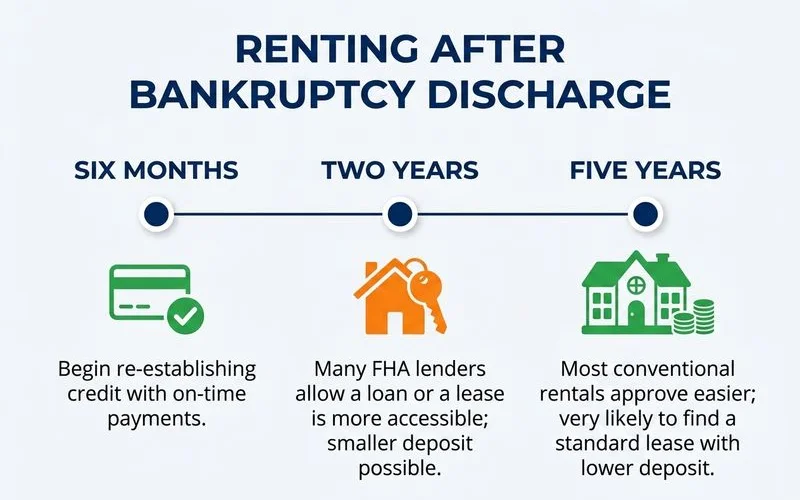
Properties in Texas typically require a one to two-year clean history after your court discharge date. Time is your biggest asset for securing better apartment options. A 2026 report from WalletHub notes that the average credit score drops to about 530 immediately after a bankruptcy.
Our leasing agents see this low score restrict your initial choices. Renters searching for discharged bankruptcy apartments with a court order under one year old still have real options at older garden-style communities. These second-chance-friendly properties focus on your current income rather than your past credit.
We watch many renters bounce back to a 600 or 650 credit score within 12 to 18 months. This rapid recovery significantly widens your pool of available housing. Most standard complexes will gladly approve your application once you cross that two-year mark.
Properties generally fall into four distinct look-back categories:
- Lenient communities: Managers approve discharged cases immediately with no time restrictions.
- Standard communities: Management requires one to two years of clean history post-discharge.
- Stricter communities: Leasing offices demand two to five years of clear financial behavior.
- Premium communities: Owners require seven or more years or strictly prohibit any bankruptcies at all.
How Bankruptcy Shows Up Alongside Other Flags
Financial distress rarely shows up as a single isolated mark on your screening report. A bankruptcy usually appears alongside a cluster of other negative indicators. Most communities that accept discharged bankruptcies are already prepared to overlook these companion signals.
Our experience shows that the entire application package matters much more than one specific line item. Third-party screening companies in Texas look closely at your complete financial behavior leading up to the court filing. Property managers expect to see a history of late payments before the official discharge date.
You will almost certainly have a credit score below 600 right after the court closes your case. Unpaid debts that legally survived the court order will also remain active on your report. Debts like federal student loans and certain tax obligations are generally not dischargeable under U.S. law.
Here are the most common companion flags we see on background checks:
- Recent eviction filings leading up to the financial collapse
- High credit utilization ratios on any remaining open accounts
- Active collection accounts for non-dischargeable medical or tax debts
- Multiple hard credit inquiries from before the court filing
What Documents to Bring
You must bring your physical court discharge order and recent proof of income to the leasing office. These documents provide hard proof that the legal case is fully closed and your debts are resolved. This documentation fundamentally changes your risk profile compared to what an automated screening report suggests.
We strongly suggest organizing your documents into a physical folder before touring any property. The actual court order showing your case was closed is your most important asset. The U.S. Bankruptcy Court issues Official Form 318 for Chapter 7 discharges and Form 3180W for Chapter 13 cases.
You must keep these specific federal forms readily accessible for the leasing agent. Our team also recommends printing out your most recent proof of income. Bring at least three to four consecutive pay stubs or 60 days of complete bank statements to verify consistent deposits.
Make sure your application packet includes these essential items:
- Discharge paperwork: The official court order (Form 318 or 3180W) proving the case closure.
- Proof of post-discharge income stability: Employment offer letters, recent pay stubs, or bank statements.
- Updated credit report: A current copy showing that old debts are settled and new credit lines are paid on time.
- Letter of explanation: A brief summary of your financial recovery.
Letter of Explanation Template
A successful letter of explanation outlines the cause of your filing and highlights your recent financial stability. Property managers read dozens of these letters every month, so keep yours concise. Keeping your explanation under 300 words ensures the agent actually reads the entire document.
We always remind clients that honest transparency beats an elaborate story. A simple one-page letter using bullet points is highly effective for a bankruptcy-related application. You want to clearly separate the past financial issue from your current leasing stability.
Our templates focus on presenting just the necessary facts without oversharing emotional details. A professional tone works best for these situations. We help renters write these letters to ensure they make a strong impact.
Format your explanation using these four key sections:
- The cause: Provide a brief factual statement about the medical bills, divorce, or job loss.
- The action: State that you filed and successfully discharged the debt. List the exact discharge date.
- The recovery: Highlight your stable employment and responsible bill payments since the court order.
- The forward look: Include a short statement confirming you are financially stable and fully committed to a new lease.
Risk Fees and Higher Deposits
Getting approved on conditional terms often involves paying slightly more upfront. Texas application fees currently average between $50 and $100 per adult. Property managers use this non-refundable money to cover the actual costs of background and credit checks.
We want you to protect your money during the application process. Texas state law requires landlords to provide written tenant selection criteria before you pay any application fees. This legal requirement lets you review their exact policies before you risk your cash.
These upfront costs are generally manageable when you plan ahead. Here is a quick comparison of standard costs versus conditional approval costs in Texas:
| Fee Type | Standard Applicant | Conditional Applicant | Refundable? |
|---|---|---|---|
| Application Fee | $50 to $100 | $50 to $100 | No |
| Risk Fee | $0 | $200 to $500 | No |
| Security Deposit | 1x Monthly Rent | 1.25x to 1.5x Rent | Yes |
Our agents know that a conditional approval is still a major victory. The property will likely require that non-refundable risk fee of $200 to $500. This is a very common practice for post-bankruptcy applicants at second-chance-friendly communities across Houston.
What If You Discharged Less Than a Year Ago?
Applying for a lease during the first 12 months post-discharge is the trickiest window to manage. Many communities demand at least a full year of financial stability before offering an approval. Your options are limited but certainly not impossible.
We specifically target apartments that accept bankruptcy houston residents rely on for immediate housing. A manual review by an independent landlord works much better than automated corporate screening. Our team helps you explore these specific short-term solutions:
- Older garden-style communities: Properties in Pasadena, Spring Branch, Baytown, or Memorial often skip year-restricted screening rules.
- Corporate guarantor services: These companies act as a co-signer if you can prove an income of at least two times the monthly rent.
- Enhanced deposits: Some mid-rise communities grant conditional approval if you pay a security deposit equal to two months of rent.
We focus your search list strictly on the properties likely to approve your specific discharge timeline. A targeted approach saves you from wasting money on guaranteed application denials.
How to Move Forward
Your goal to rent apartment after bankruptcy simply requires the right preparation and documentation. Always bring your physical discharge paperwork directly to the leasing office. Be completely honest on the application about your past financial challenges.
We highly recommend using a free pre-screened search to find properties that fit your background. This ensures you only apply where the community actually accepts your specific situation.
Start your free post-bankruptcy search or read our complete guide on conditional apartment approval.