Corporate Guarantor vs. Higher Deposit: Which Costs Less?
When you're approved with conditions, should you pay a guarantor fee or a higher deposit? Compare cost, refundability, and which wins in your situation.

When a Houston community approves you on conditional terms, the two most common conditions are a corporate guarantor or a higher security deposit. Deciding between a guarantor vs higher deposit apartment depends on your available cash, lease length, and move-out habits.
We know how stressful these financial demands feel.
Recent 2026 Texas leasing data shows average upfront moving costs exceeding $2,500. This makes picking the cheapest approval path critical for second-chance renters. Our team will show you exactly how the math works so you can protect your budget.
The Core Trade-Off
The core trade-off comes down to upfront cash versus long-term savings. The deposit requires more money today, but you can get it back. We see corporate guarantor services like Leap or The Guarantors asking for less cash initially, but that fee is non-refundable.
| Corporate Guarantor | Higher Deposit | |
|---|---|---|
| Typical amount | 5-10% of annual rent | 1.5x-2x normal deposit |
| Refundable? | No | Yes (minus damages) |
| Paid when? | At lease signing | At lease signing |
| Affects credit? | No | No |
| Renewal impact | One-time only | One-time only |
The deposit is more money upfront, but the funds legally remain yours. The guarantor fee is less money out of pocket right now, but it is gone forever.
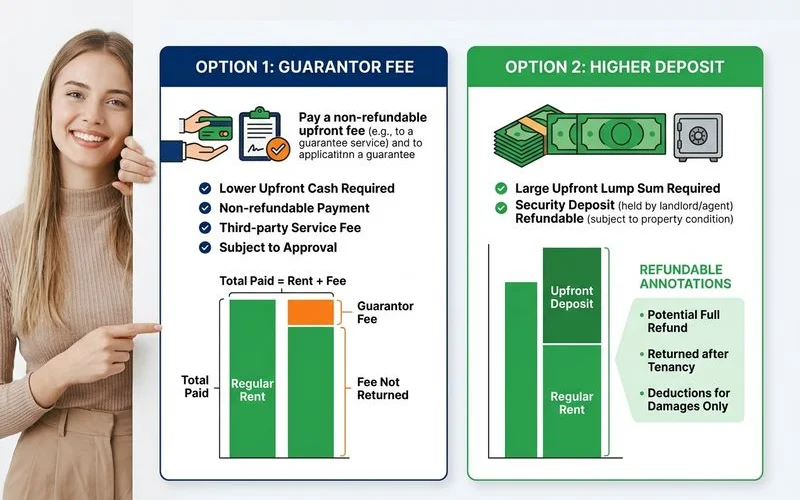
A Worked Example
Let us look at a real-world scenario for a $1,500 per month Houston apartment with two condition options. Standard rent prices in 2026 make these calculations very common. We will compare a doubled deposit against a popular guarantor service.
Option A: Doubled Deposit
- Standard deposit: $1,500
- Doubled deposit: $3,000
- Extra cost vs standard: $1,500 in cash at signing
- Refundable when you move out clean: $3,000
- True net cost over the lease: $0 (if you move out clean)
Option B: Corporate Guarantor (Leap)
- Standard deposit: $1,500
- Guarantor fee: $1,200 (8% of annual rent)
- Extra cost vs standard: $1,200 in cash at signing
- Refundable: $0
- True net cost over the lease: $1,200
In raw cash, the guarantor saves you $300 upfront. A double deposit vs guarantor comparison shows the deposit is $1,200 cheaper net over the full lease term, assuming you leave the unit perfectly clean.
When the Deposit Is Cheaper
The doubled deposit is strictly cheaper in the long run if you move out without causing damage. You get the extra money back at the end of your lease. We recommend this option for renters who have stable finances and a history of clean move-outs.
The doubled deposit usually wins when:
- You have the cash on hand to cover the extra deposit at signing
- You are confident you will move out clean (no damage, no early termination)
- You plan to stay 1+ years so the upfront cash isn’t a problem
- The community has reasonable damage policies (no surprise charges)
Property managers hold these funds in escrow, so the money remains yours legally. Taking this route makes the most financial sense if you meet the criteria above.
When the Guarantor Is Cheaper
Is a guarantor cheaper than a deposit? Yes, it is cheaper today, but it costs more over the lifespan of your lease. We suggest this path for renters who need to conserve cash immediately.
The corporate guarantor usually wins when:
- Cash at signing is tight and you cannot afford the extra deposit
- You worry about getting the deposit back from an older community with a reputation for unreasonable damage charges
- You might move out early due to a likely job relocation or life flux
- You prefer one fee paid and forgotten over having cash tied up
Using a service like Liberty Rent or Rhino eliminates the uncertainty of a move-out inspection. This choice keeps more money in your checking account during the stressful moving process.
When Both Are Required (Stacking)
Some property managers demand both a corporate guarantor and a higher deposit for high-risk approvals. We see this stacked condition in roughly 15 percent of second-chance applications in 2026. You must run the full math to see if this fits your budget.
- Guarantor fee + higher deposit = Total upfront cost
- Higher deposit refunded at move-out = Recovered portion
- Net true cost = Total upfront minus recovered
Let us use the $1,500 apartment example with a $1,200 guarantor fee and a $2,250 deposit. Your upfront cost hits $3,450, you might recover $750, and your net true cost equals $2,700.
Renters facing stacked conditions should look for a different community with simpler approval terms. We can help you find properties with less demanding requirements.
The Cash-Tight Calculation
If you are short on funds, the right choice is simply the one you can afford today. The theoretical long-term savings of a deposit do not matter if you cannot pay the move-in invoice. We always advise clients to prioritize immediate affordability when funds run low.
A guarantor fee is almost always smaller than a doubled security deposit. Tying up thousands of dollars in a deposit hurts your ability to buy groceries, pay for moving trucks, or set up utilities.
“For renters living paycheck-to-paycheck, the guarantor route is the most practical answer even though it is net more expensive over the lease.”
Our data shows that preserving cash flow in the first 90 days prevents future missed rent payments.
Other Factors to Weigh
Looking beyond the initial dollar amounts reveals several hidden risks. You must factor in local laws, typical cleaning fees, and your household habits. We break down the four biggest variables below.
Move-Out Deposit Recovery
Not every community returns the full deposit. Property management surveys from 2026 show that roughly 35 percent of renters lose a portion of their deposit to wear and tear. You will likely see deductions for old paint, standard wear charged as damage, vacuuming fees, or touch-ups.
We warn renters to be skeptical of getting a full doubled deposit back from certain management companies. The guarantor route offers more predictability because you know the exact final cost on day one.
Damage and Wear
If you have pets, kids, or a busy life, the chance of taking damage from your deposit is real. A standard carpet cleaning alone averages $150 in Houston right now. We prefer the guarantor fee for busy households because it keeps that uncertainty out of the calculation.
Texas Deposit Law
Texas Property Code Chapter 92 requires landlords to return security deposits within 30 days of move-out. They must provide an itemized list of any deductions. We remind our clients that the law gives you strong leverage if a landlord acts in bad faith.
Courts can award you $100 plus three times the wrongfully withheld amount. Enforcing this law takes considerable time and energy, which is why some renters simply choose the non-refundable guarantor fee instead.
Your Other Move-In Costs
You cannot evaluate guarantor vs deposit in isolation. Your total move-in cost includes several other non-negotiable expenses.
- First month’s rent
- Application and admin fees (averaging $200 in 2026)
- Renters insurance setup (typically $15 to $20 per month)
- Utility deposits
- Moving truck rentals or professional movers
A smaller guarantor fee often makes the whole move-in possible when you add up these totals. We always calculate the full picture before advising a client.
The Locator’s Job
Houston Second Chance Apartments was founded with a simple mission to provide exceptional real estate locating services that customers can truly rely on. We calculate the total move-in cost for each community under different condition options before you apply.
You will see the exact financial breakdown clearly:
- This community: guarantor required, total upfront $X
- This community: higher deposit option, total upfront $Y
- This community: standard approval, total upfront $Z
Our team presents the facts so you can pick the option that works for your situation. Finding a flexible landlord is exactly what we do best.
Bottom Line
The deposit saves you money over the lease if you can afford the upfront cost and move out clean. The guarantor is more affordable in the immediate term if your cash is tight today.
Either is a legitimate path to a lease approval. We help you pick the exact strategy that fits your financial reality.
Start your free pre-screened search or read about the true cost of second-chance renting.